SharePoint Broken Link Checker: Find, Fix, and Prevent Dead Links Across Your Sites
Published:
Last updated: 2026-11-01
If you manage a SharePoint environment of any meaningful size, you already know the problem: broken links are everywhere. They hide in page content, web parts, navigation menus, list items, and document libraries. They accumulate silently after site migrations, file renames, reorganizations, and permission changes — and they surface at the worst possible time, usually when an executive or a client clicks one.
SharePoint Online now has a basic native option for broken links on site pages (covered below), but there is still no tenant-wide report, no dashboard, and no scheduled scan that tells you which links across your sites, documents, and lists are dead. Microsoft's older tools like SharePoint Designer have been deprecated, and the SharePoint admin center offers nothing for link health monitoring.
That gap is exactly what the Broken Link Manager, part of the SharePoint Essentials Toolkit, was built to fill.
The Real Cost of Broken Links in SharePoint
Broken links are more than a cosmetic problem. In an enterprise SharePoint environment, they carry real costs:
Lost productivity — Users waste time hunting for content that has moved or been deleted. A broken link in a process document can stall an entire workflow.
Erosion of trust — When users encounter dead links, they lose confidence in the intranet. Over time, they stop using SharePoint as a reference and fall back to email, local files, or asking colleagues directly.
Compliance and governance risk — In regulated industries, links to policies, procedures, and training materials must remain functional. A broken link to a compliance document during an audit is not a good look.
Migration debt — Every migration — from on-premises to SharePoint Online, from classic to modern, from one tenant to another — generates broken links at scale. Without tooling, this debt compounds.
Why Finding Broken Links in SharePoint Is So Hard
SharePoint is not a simple website. Links can exist in dozens of different locations and formats:
Page content (modern and classic pages)
Web part configurations
List item columns (hyperlink, rich text, and calculated fields)
Navigation nodes (global, hub, and local navigation)
Document library metadata
Managed metadata term store links
A typical web crawler only sees rendered HTML. It misses links buried in list data, metadata fields, and web part properties. Even if you could crawl every page, SharePoint's authentication model means standard HTTP crawlers can't access content behind permissions without proper integration.
Manual auditing is not viable either. A mid-sized organization with 200 site collections and thousands of pages would need weeks of manual effort to check every link — and by the time the audit is complete, new broken links have already appeared.
Does SharePoint Have a Built-In Broken Link Checker?
Yes, partly. SharePoint Online has a native Fix broken links option under Improve this site, part of Microsoft's SharePoint Knowledge Agent. Microsoft announced it on September 18, 2025 (Message Center MC1155312), with the public preview rolling out worldwide from mid-September 2025 through late February 2026. It is still listed as a preview, and Microsoft's roadmap targets general availability for September 2026.
How to check for broken links natively in SharePoint Online
- Open the SharePoint site you want to check. You need edit permission on at least one page that contains the broken link; site owners and editors qualify.
- Select Improve this site.
- Select Fix broken links.
- Review the list. For links on your own site's pages, select View to open the page and edit the link, or set up a redirect to a new destination.
- For broken links reached from outside the site (an email, another site, or an unknown source), set up a redirect, since the originating page can't be shown.
- Dismiss or snooze suggestions you don't want to act on now. To see redirects you've created, open the ellipsis (...) menu and select Show redirected links.
Limits of the native option: it only finds links that visitors actually hit (404 errors), it only covers site pages, and it works one site at a time, with no central view across a hub or tenant. The Knowledge Agent preview also has its own opt-in and licensing requirements. It won't proactively scan links inside documents, list items, navigation, or links to files and folders that nobody has clicked yet. That's where a full scan with the Broken Link Manager comes in.
How the Broken Link Manager Works
The Broken Link Manager in the SharePoint Essentials Toolkit takes a fundamentally different approach from generic link checkers. Instead of crawling rendered HTML, it queries SharePoint directly through its APIs, inspecting content at the data level across sites, lists, libraries, and pages.
Scanning and reporting
You select the sites you want to scan — a single site, a selection of sites, or your entire tenant. The tool then:
Enumerates all pages, list items, and document libraries across selected sites
Extracts every hyperlink from rich text fields, hyperlink columns, page content, and web part configurations
Validates each link by checking HTTP status codes (200, 301, 404, 500, etc.)
Generates a detailed report showing exactly where each broken link lives, what status code it returned, and what the link text says
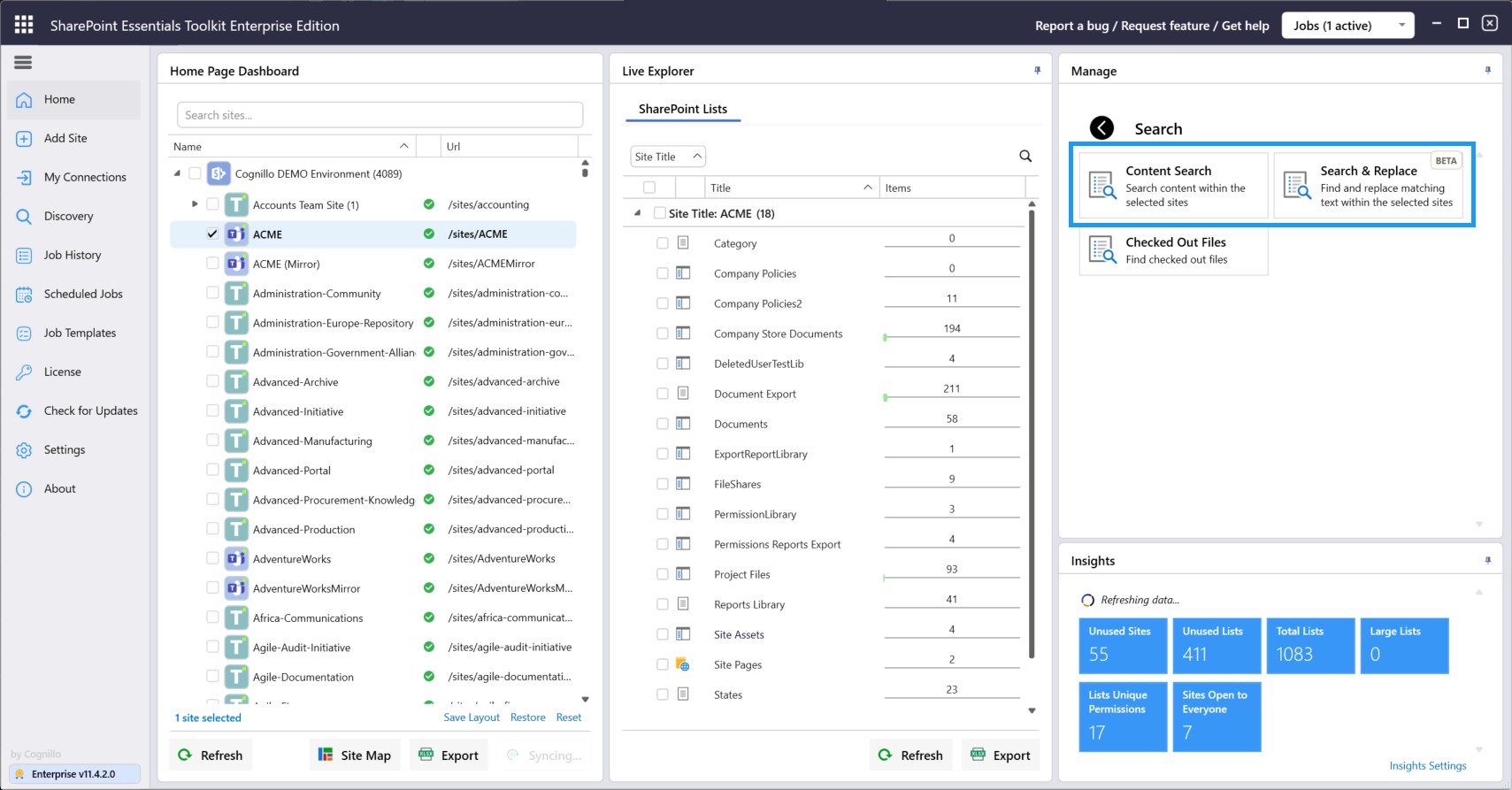
The report is actionable. You can filter by status code, site, or content type. You can export results to Excel for stakeholders. And critically, you can fix links directly from the results.
Find and replace
Finding broken links is only half the battle. The Broken Link Manager includes a powerful find-and-replace engine that lets you fix links in bulk across your SharePoint environment. Renamed a site? Changed a domain? Moved a document library? You can update every affected link in minutes instead of days.
The find-and-replace works across all the same content types the scanner inspects — pages, list items, web parts, and metadata. It handles partial URL matching, so you can replace a domain prefix or path segment across thousands of links in a single operation.
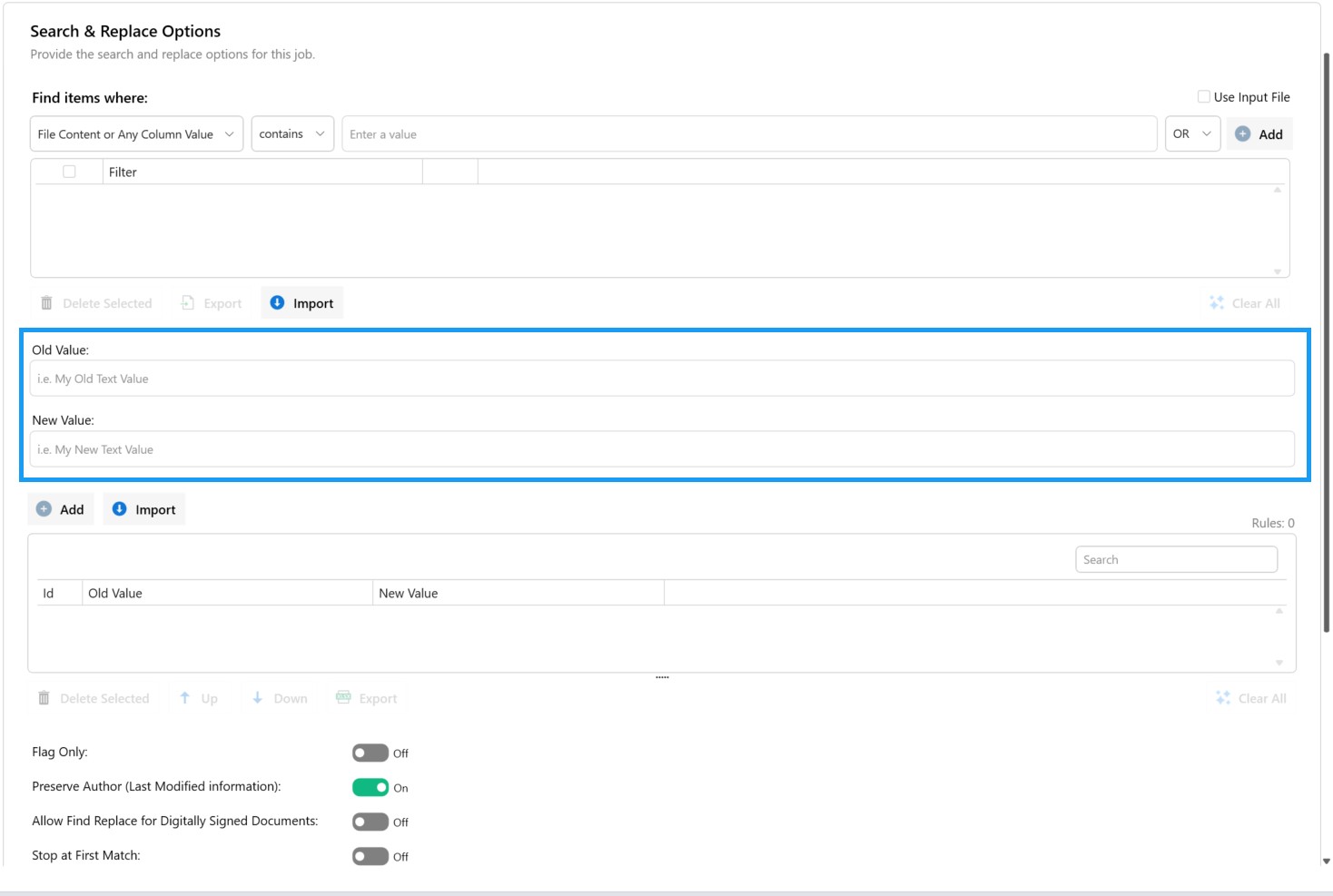
For a detailed walkthrough, see our help article on how to automatically fix links in SharePoint.
Proactive Link Maintenance
Fixing broken links reactively is important, but the real value comes from preventing them in the first place. The Broken Link Manager supports scheduled scanning, so you can run regular link health checks on a daily, weekly, or monthly basis.
This turns link management from a one-time cleanup project into an ongoing governance process:
Scheduled scans run automatically and generate reports you can review at your convenience
Trend tracking lets you see whether your link health is improving or degrading over time
Early detection catches broken links within days of them appearing, before users report them
By integrating link health into your regular SharePoint governance routine, you keep your environment clean and your users confident that the links they click will actually work.
What Types of Links Are Covered?
The scanner processes a wide range of link types that go far beyond what a simple web crawler can detect — including complex links that point to other files, folders, and documents:
Standard hyperlinks in page content and rich text fields
Complex SharePoint links — durable links (right-click → Copy Link), Document ID service links, and sharing links
Links inside documents stored in libraries and list attachments — Word, Excel (including cell and formula links), PowerPoint, Visio, OneNote, PDF, HTML, XML, and more
Links to files and folders, including file shares and UNC paths (e.g., \\server\share) outside SharePoint
Image source URLs
Links in SharePoint navigation (top nav, quick launch, hub nav)
Hyperlink columns in lists and libraries
Links embedded in web part properties
Cross-site and cross-tenant links
For the full list of supported link types, see What Type of Links Will Be Processed?
Part of the SharePoint Essentials Toolkit
The Broken Link Manager is one module within the SharePoint Essentials Toolkit — an all-in-one administrative toolkit for SharePoint that also includes permissions reporting, content auditing, site inventory, and more.
All data processing happens locally on your machine. No data leaves your environment, no cloud service sees your content, and no third-party has access to your SharePoint data. This makes it suitable for organizations with strict data sovereignty requirements.
The toolkit is available in Community (free), Professional, and Enterprise editions — and broken link reports don't require a paid edition. The free Community Edition never expires and runs broken link reports at full depth on up to 20 SharePoint site collections per tenant, so you can scan a small environment or try the toolkit at no cost. Find-and-replace and scheduled scanning are available in Professional and Enterprise editions.